
The essentials in 30 seconds
- The official TCF Canada is a paid test taken at an approved centre. Practice tests are free — certificates are not.
- A mock test predicts your result only if you copy exam conditions: timer, single listening, no dictionary, no pauses.
- Read your result skill by skill against the CLB/NCLC chart — your weakest skill decides eligibility.
- Retaking the same series inflates your score. Use a new series each time you measure progress.
Contents
What a good free practice test should include
| Feature | Why it matters |
|---|---|
| All four sections | Writing and speaking often decide whether you reach NCLC 7. |
| 39 listening + 39 reading questions | Matches the real TCF Canada format and difficulty curve. |
| Real audio, played once | The exam never lets you replay a recording. |
| Official timings (35 / 60 / 60 / 12 min) | Time pressure is part of the skill being tested. |
| Score estimate by skill | You need a level for each skill, not a single average. |
Our free trial includes two complete TCF Canada series in this format, with no credit card required.
How to take it so the score means something
Book a real slot in your calendar
Same time of day as your future exam, 3 hours, phone in another room.
Use headphones and play each recording once
If you replay audio, your listening score is no longer a prediction.
No dictionary, no translator, no notes app
Write your essays by hand or in a plain editor and count the words yourself.
Record your speaking tasks
Use your phone. Listen back the next day with fresh ears — or have a teacher assess it.
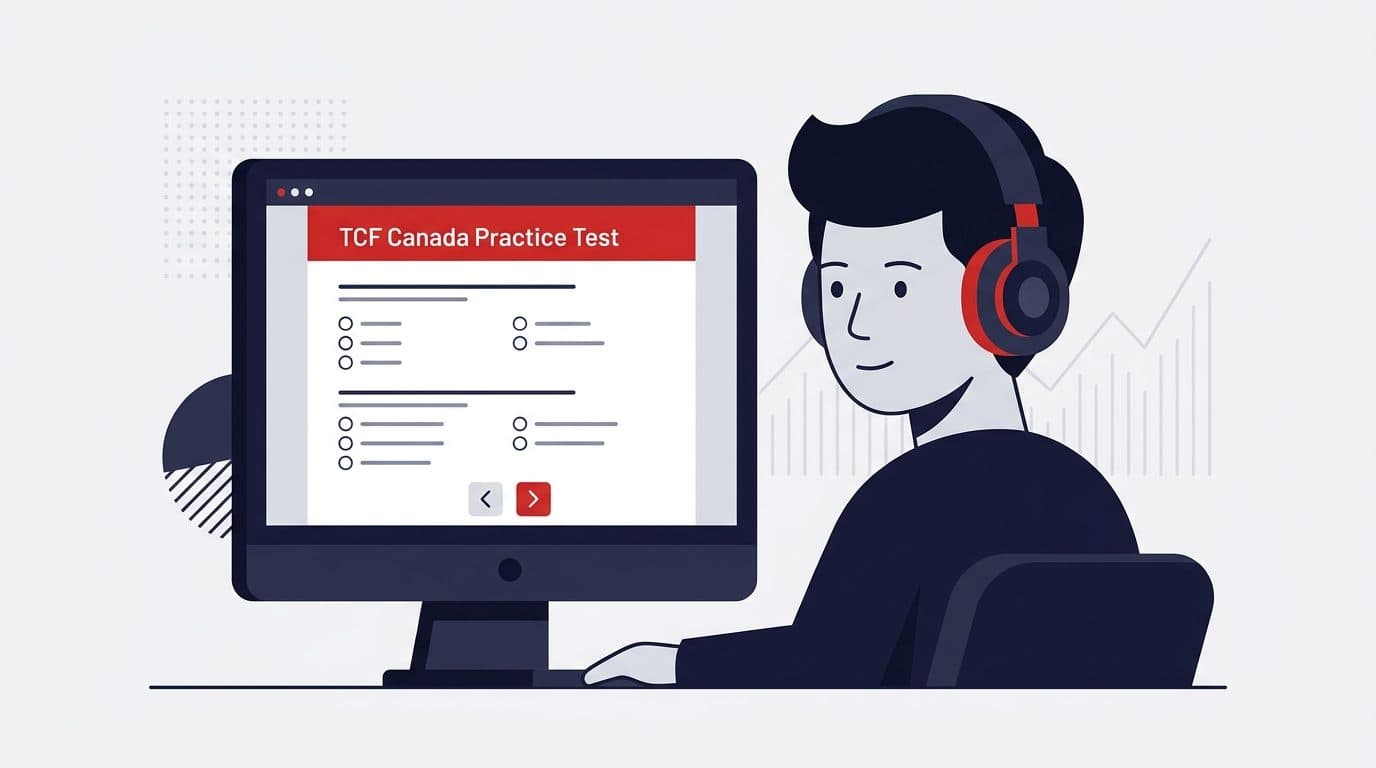
“A practice score is only as honest as the conditions you took it in.”
Reading your results
Convert each skill using the official chart. For the common target of NCLC 7, you need 458 in listening, 453 in reading and 10/20 in speaking and writing. The complete chart is here: TCF Canada Score Chart 2026. You can also enter your scores into our NCLC simulator.
| Practice result vs. your target | What to do |
|---|---|
| 30+ points above in listening/reading, +1 in writing/speaking | You are close to test-ready. Book the exam. |
| 0–30 points above | Borderline. Take 2 more full series before booking. |
| Below the target by up to 50 points | Plan 4–6 weeks of focused work. |
| Below by more than 50 points | Plan 2–3 months; prioritise daily listening. |
What a practice test cannot tell you
- Your exact official score. Real test forms differ; treat your result as a range, not a promise.
- Your test-day nerves. Most candidates lose some points on the day. Build a margin.
- Your writing and speaking level, if nobody assesses them. Self-marking is always generous.
Take the free TCF Canada practice test
Two complete series, official format, estimated CLB/NCLC by skill. No credit card.
Start for freeNewsletter
One email a week to pass the TCF
Join 2,000+ candidates who get our weekly current-affairs topics and exam tips.
No spam. Unsubscribe in one click.
Frequently asked questions
Is there a free TCF Canada practice test?
Yes. You can take free full-length TCF Canada practice series online, including ours, which offers two complete series in the official format. The official exam itself is paid and taken at an approved test centre.
How accurate are TCF Canada practice tests?
A well-built practice test taken under real conditions gives a useful range. Expect your official result to be somewhat lower than your best practice score because of test-day stress, so aim above the cut-off.
Can I take the TCF Canada online from home?
No. The official TCF Canada is taken in person at a centre approved by France Éducation international. Online tests are for practice only.
How many practice tests should I take?
Take one at the start to diagnose your level, then a new full series every two to three weeks, and at least three in the final two weeks before the exam.
About the author
Daniel Maurise
French coach — France, DELF and English-speaking candidates
Works with Felix Academy learners heading to France, preparing DELF or DALF, and English-speaking candidates.
Did this article help?
Comments(0)